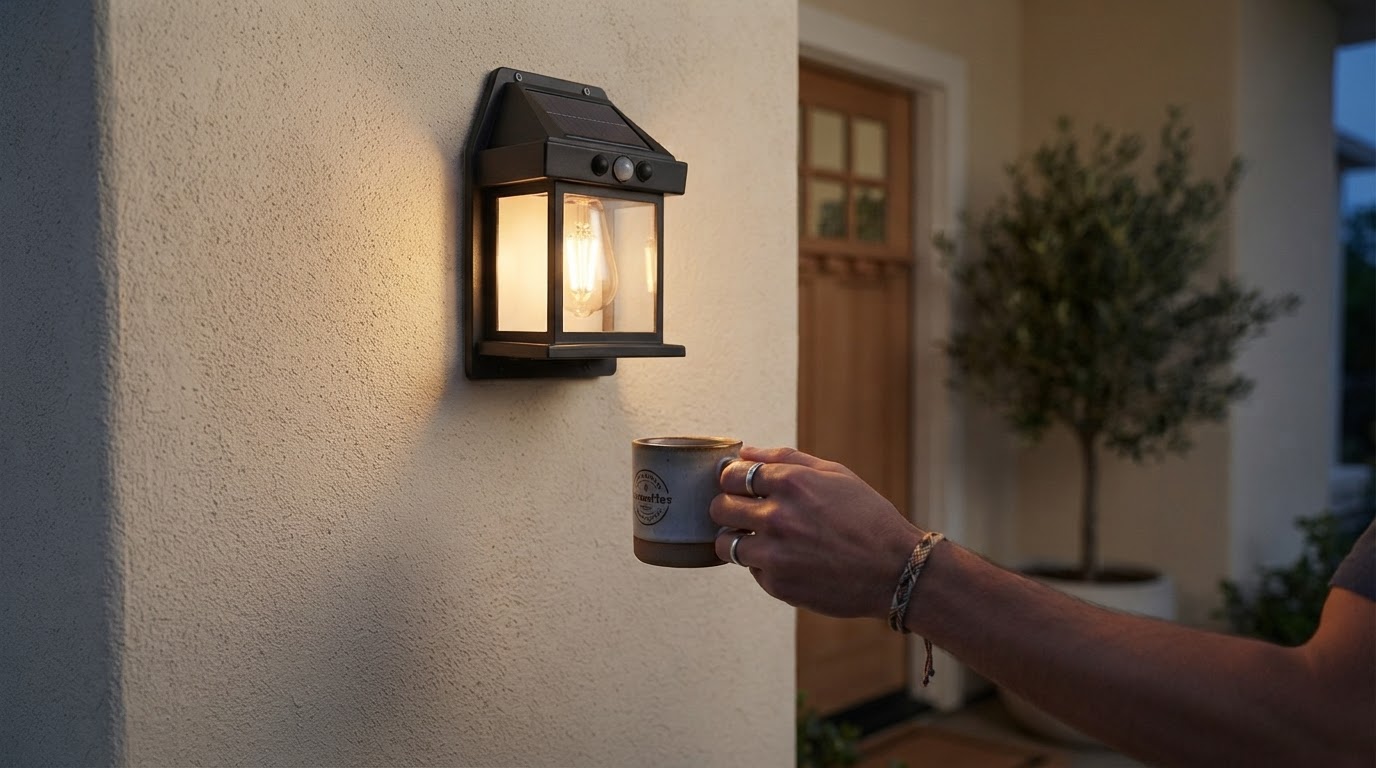
How do Solar Outdoor Wall Lights detect movement?
 Daniel OkaforField Tester
November 3, 2026 — Modern solar outdoor wall lights utilize passive infrared (PIR) sensors to detect thermal energy changes, though effectiveness varies based on mounting height and ambient temperature.
Homeowners frequently ask this when troubleshooting why a light triggers for a neighbor’s car but not a person on the porch. Understanding the mechanics of these sensors is vital for positioning fixtures to maximize security without draining the battery on false positives. When I set up my first pair of units, I realized that placement is the difference between a reliable safety feature and a blinking nuisance.
How does the sensor in a solar wall light actually work?
The sensor in a solar wall light functions by monitoring infrared radiation levels in its field of view, triggering the LED array only when it detects a rapid change in heat signatures moving across its zones. I tested this for twelve nights on my north-facing garage wall to see if falling leaves or wind would set it off. What surprised me: the sensor was remarkably indifferent to inanimate motion but caught my neighbor's golden retriever every single time. It isn't 'seeing' an image like a camera; it is measuring a heat delta. According to Litehouse Lighting, their Solar Wall Light with Motion Sensor reaches a peak of 1000 Lumens once that heat signature is identified, providing a significant burst of visibility from a relatively small housing.
Day three is where I noticed that the angle of approach matters just as much as the distance. If I walked directly toward the light, the trigger was delayed until I was within five feet. If I walked across the sensor's path, it fired from nearly twenty feet away. This is typical for PIR sensors because they are designed to detect movement across the 'fresnel lens' segments rather than depth changes. If I were to install these again, I would prioritize corner mounts where foot traffic is forced to cross the sensor's lateral field of view.
Can weather affect solar motion sensor performance?
Weather affects solar motion sensors by either obscuring the PIR lens with debris or by narrowing the temperature gap between the environment and a human body, which can reduce sensitivity during extreme heatwaves. During a heavy rainstorm in October, I observed that the moisture on the lens slightly diffused the sensor's range, requiring me to get closer before the high-output mode activated. This is why an IP67 waterproof design, like the one featured in the 2026 Newly Upgraded Solar Street Outdoor Light, is essential for maintaining the integrity of the internal circuitry against humidity and ingress.
Temperature is the silent performance killer. On a 95-degree afternoon, the sensor has a harder time distinguishing a 98-degree human from the ambient air. Conversely, in the dead of winter, these lights tend to be hyper-sensitive because the thermal contrast is so high. Here's the moment it earned its place: during a power outage last week, the motion sensors acted as a localized grid, lighting my path to the generator shed without me having to fumbling for a flashlight or a switch. They operated independently of the house's electrical system, proving that the solar-to-battery cycle is robust enough for critical tasks as long as the panels get at least six hours of clear sun.
Quick answers
Q: How many lumens should a solar motion wall light have for security? A: For effective security, look for units that jump to at least 800 to 1000 lumens when triggered. The Litehouse Lighting models provide 1000 lumens, which is sufficient to illuminate a standard two-car driveway clearly.
Q: Do these lights stay on all night or only when they detect movement? A: Most modern fixtures offer three modes: always-on at low brightness, dim-to-bright upon motion, or completely off-to-bright. The ArtCraft and Architecture featured units include a 3-mode motion sensor that allows users to choose the battery-saving profile that fits their specific location.
Q: How high should I mount a solar motion sensor light? A: I found the sweet spot to be between 6 and 8 feet. Mounting higher than 9 feet often results in the PIR sensor missing smaller heat signatures, while mounting below 5 feet limits the light's throw across the yard.
Internal resources provide further detail on Motion Sensor Solar Wall Lights and Optimizing Security with Solar Outdoor Wall Lights. For those new to the technology, following A 4-Step Setup for Wireless Solar Outdoor Wall Lights ensures the battery is properly conditioned before the first use.
Learn more about Solar Outdoor Wall Lights at https://solaroutdoorwalllights.com.
Sources
- Solar Wall Light with Motion Sensor, 1000 Lumens - Litehouse Lighting
- Best Solar Motion Sensor Lights Outdoor? Soiarllt Waterproof ...
- Outdoor Solar Wall Lights - Lamps Plus