
Outdoor Solar Porch Light Placement: 5 Aesthetic & Charging Rules
Many homeowners assume solar wall lights can be mounted in the exact same positions as traditional hardwired sconces without checking sunlight patterns. However, top-mounted solar panels require direct sun intake that deep eaves often block. For ideal curb appeal and automatic dusk-to-dawn performance, mount outdoor solar porch lights 60 to 66 inches from the floor, positioned 6 to 12 inches from door trim. Ensure the top solar panel sits forward of roof soffit shadow lines to receive 6 to 8 hours of direct daily sun rays.
Visual Positioning & Clearance Blueprint
This diagram details the core architectural measurements for framing standard exterior entryways while protecting top-mounted solar panel charging zones.
In residential exterior lighting design, the eye-level mounting rule serves two key functions: it eliminates harsh upward glare into visitors' eyes and casts an even downlight wash across entry steps. Standard exterior doors in the United States measure 80 inches (6 feet 8 inches) in height. Positioning solar wall sconces so their centers sit roughly one-fourth to one-third down from the top of the door frame places the fixture center point right at 60 to 66 inches above the porch floor.
When positioning fixtures along garage bays or long exterior perimeter walls, this height can adjust slightly upward to 66 to 72 inches. This higher mounting position accommodates wider garage door frames while casting a broader illumination beam across driveways and vehicle entry points. However, mounting higher than 72 inches should be avoided for solar fixtures, as high elevations make cleaning the top solar panel and toggling the power mode switch difficult during regular maintenance.
5 Placement Strategies for Every Architectural Layout
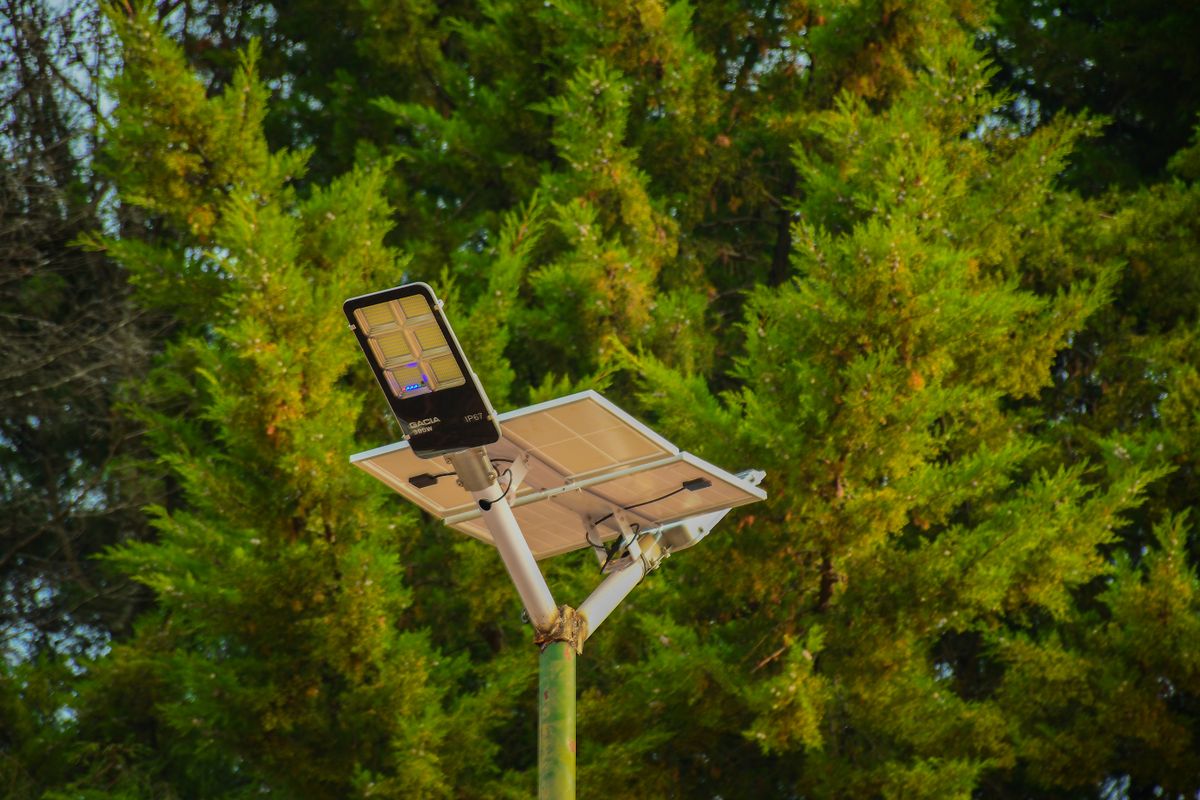
Photo by finix photographer on Pexels
Framing Standard Single Front Doors — Mount two fixtures symmetrically at 60 to 66 inches above the floor, spaced 6 to 10 inches from the door casing, ensuring top panels clear the front porch roof line.
Double-Car Garage Bays — Place fixtures 66 to 72 inches high on the outer piers and center column, maintaining 8 to 12 inches of lateral spacing from garage door trim to project a wider downlight beam across the driveway.
Deep Covered Porches & Soffits — Position fixtures forward on outer porch posts or extend brackets beyond deep roof eaves so top-mounted poly-silicon solar panels receive at least 6 hours of unshaded daylight.
Patio & Deck Perimeter Walls — Install lights at 60 inches from deck boards near seating zones to eliminate glare while casting ambient light across steps and walking paths.
Side Exterior Pathways & Walkways — Space fixtures 8 to 12 feet apart along side walls at a height of 64 inches, utilizing motion sensor mode to provide pathway visibility when approaching side entrances.
Selecting the correct height and offset depends on your home's structural framing and exterior wall geometry.
Modern wireless solar wall lights rely on integrated photocells and passive infrared (PIR) motion sensors. Because these units generate their own power using high-efficiency poly-silicon solar panels, fixture orientation directly influences battery charging cycles. Top-mounted solar panels require unshaded exposure during peak solar intensity hours (10:00 AM to 2:00 PM) to convert light into storeable energy inside internal 3.7V/2200mAH batteries.
Simultaneously, the motion sensor lens must cover approach zones effectively. Mounting a light with a 19-foot induction radius too high tilts the PIR cone upward, missing approaching foot traffic or pets altogether. Aligning the solar intake panel outward toward unobstructed sky while pointing the sensor lens downward across entry pathways ensures your lights charge fully by day and trigger reliably by night.
Critical Solar Wall Light Placement Mistakes to Avoid
Prevent early battery drain and harsh lighting glare by avoiding these frequent installation errors.
Exterior Lighting Inspiration Gallery
Visual inspiration for positioning wireless solar wall lights across brick, vinyl siding, and porch posts.
Key Placement Rules Summary
- Mount fixtures between 60 and 66 inches from the floor to achieve eye-level balance and minimize bulb glare.
- Maintain 6 to 12 inches of horizontal offset from door frames and trim for clean visual framing.
- Ensure top-mounted poly-silicon solar panels receive 6 to 8 hours of direct, unshaded sun exposure daily.
- Position top solar panels forward of roof eave shadow lines to maintain optimal battery charging.
- Utilize 3 lighting modes (including 19FT induction motion detection) to balance decorative ambience and home security.
Printable Wall Light Installation Cheat Sheet
- Ideal Mounting Height: 60 - 66 inches from ground level to center of fixture.
- Door Casing Offset: 6 - 12 inches from outer trim edge.
- Garage Bay Clearance: 66 - 72 inches height, 8 - 12 inches from bay trim.
- Direct Sunlight Requirement: Minimum 6 - 8 hours uninterrupted sun exposure on top panel.
- Overhang Shadow Offset: Place fixture center at distance = 1.5 x roof overhang depth from back wall line under soffits.
- Motion Sensor Testing: Verify 19FT detection arc before final bracket tightening.
Porch & Garage Light Spacing Calculator
Calculate exact mounting spacing coordinates for framing front doors, garages, or long exterior walls.
Placement Dimensions Across Architectural Scenarios
Photo by Jan van der Wolf on Pexels
| Architectural Scenario | Ideal Mounting Height | Distance from Trim | Solar Exposure Clearance | Recommended Mode Setting |
| --- | --- | --- | --- | --- |
| Front Door Framing | 60 – 66 inches | 6 – 10 inches | Must clear porch overhang shadow line | Flicker / Ambient Glow |
| Double Garage Bays | 66 – 72 inches | 8 – 12 inches | Full top panel exposure over driveway | Motion Sensor Mode |
| Narrow Covered Porch | 60 – 64 inches | 6 – 8 inches | Mount forward on outer porch post | Motion Sensor Mode |
| Open Deck / Patio Wall | 60 – 66 inches | 12 – 18 inches | 100% open sky direct exposure | Flicker / Ambient Glow |
| Side Pathway Wall | 64 – 68 inches | N/A (Space 8-12 ft) | Avoid tree canopy and eave shading | Motion Sensor Mode |
Compare optimal height, trim clearance, solar exposure rules, and lighting modes across common exterior zones.
Pro Tip: Calibrating Top-Mounted Solar Panels with Deep Roof Eaves
When installing solar wall lights beneath roof soffits or wide eaves, calculating shadow angles is critical. During summer peak hours, a 12-inch roof overhang casts a downward shadow zone extending up to 18 inches down the exterior wall. If your top solar panel falls inside this shadow envelope during 10:00 AM to 2:00 PM, charging efficiency drops significantly. To correct this, mount lights on outer columns or use spacer blocks to bring the top solar panel forward into direct sun rays.
Explore Related Solar Lighting Guides
Expand your outdoor lighting knowledge with these essential planning resources:
- How to Mount Solar Wall Lights on Vinyl Siding Without Drilling
- Solar Wall Light Placement FAQ: Avoiding Common DIY Mistakes
- The Complete Buying Guide for All-Weather Solar Outdoor Wall Lighting Packs
Frequently Asked Questions
At what height should outdoor solar porch lights be mounted?
Mount solar porch lights 60 to 66 inches from the floor to eye level for optimal architectural balance, minimum direct glare, and easy top solar panel maintenance access.
Will solar wall lights charge under a covered porch eave?
Top-mounted solar panels require direct sun exposure. Under deep roof eaves, fixtures should be mounted forward on outer posts or mounting brackets so sunlight hits the panel for at least 6 hours daily.
How far apart should solar lights be spaced on a garage or wall?
For single entry doors, place lights 6 to 12 inches from door casing. On garage walls, space lights 6 to 8 feet apart across outer piers to provide balanced downlight coverage.
Which light mode is best for porch lighting aesthetics?
Use a continuous flicker or ambient low mode for daily decorative curb appeal, switching to 19FT motion sensor mode for high-security perimeter areas.
Get fast answers to common placement, height, and charging questions for outdoor solar wall lights.
Featured Solar Lighting Solution
Upgrade your exterior walls with reliable, wireless solar illumination engineered for all-weather outdoor performance.
Installation Action Plan
Your decision: Determine your wall structure, measure roof overhang shadows at peak sun hours, and select your visual target height.
Do this next: Perform a 24-hour sun exposure tape test before drilling permanent pilot holes.
- Read next: How to Mount Solar Wall Lights on Vinyl Siding Without Drilling
- Read next: Solar Wall Light Placement FAQ: Avoiding Common DIY Mistakes
Equip your exterior with the 4-Pack Solar Outdoor Wall Lights featuring high-efficiency poly-silicon solar panels, 3 lighting modes, and IP65 weatherproofing.
Follow these steps to complete your outdoor lighting project.
Cover photo by ROMAN ODINTSOV on Pexels.