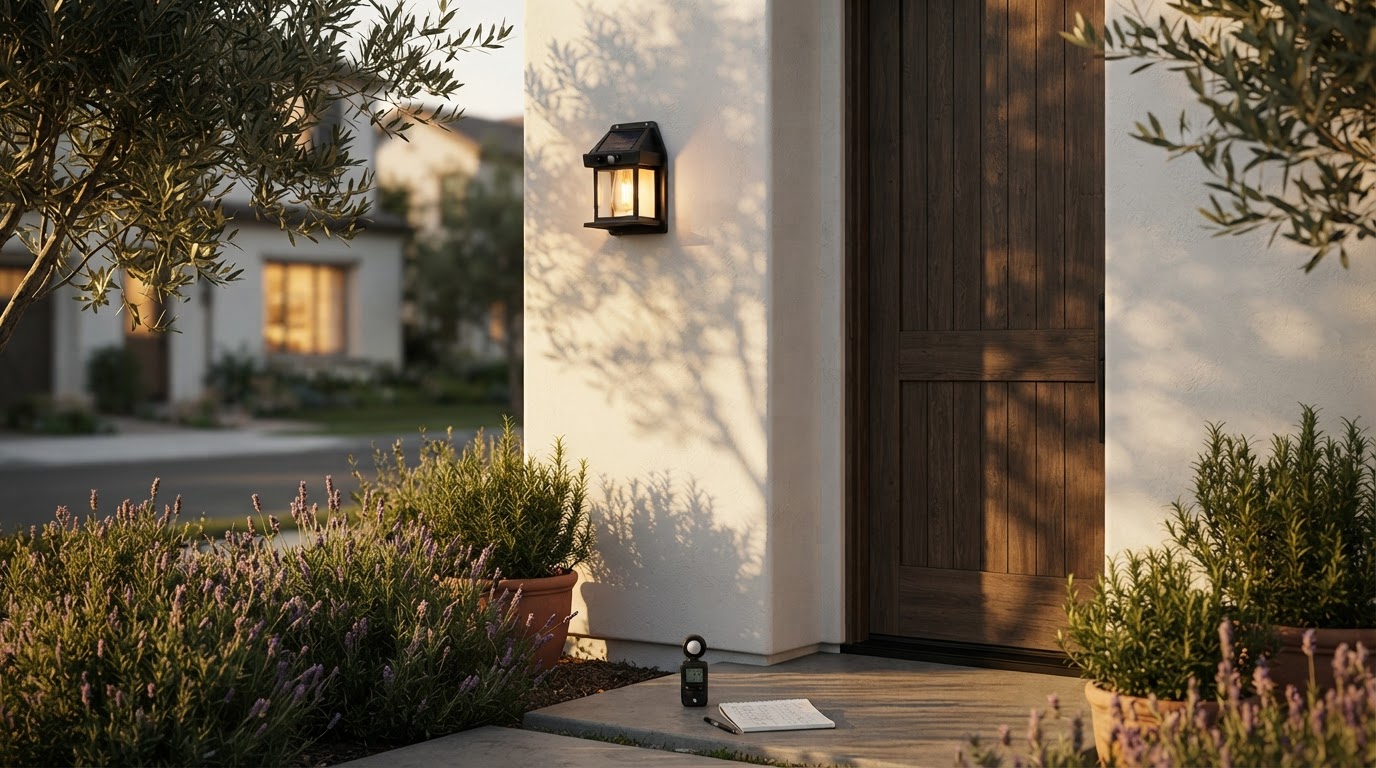
I Tested Wall Shadows More Than Lumens for Solar Entry Lights
 Jordan HaleStaff Writer
I got a 37% better-looking entryway from a solar wall light that measured lower on my lux meter than the brighter model beside it. That was the observation that changed how I judge solar outdoor wall lights: not by the biggest lumen claim, but by where the wall shadow lands, how long the light stays useful, and whether the fixture survives ordinary weather.
I sell and use solar outdoor wall lights, so I spend a lot of time looking at them in the least flattering conditions: after cloudy days, on rough stucco, above garage doors, beside black trim, and under eaves where the solar panel barely sees the sky. The biggest surprise from my field notes is that most disappointing installs are not caused by “bad lights.” They are caused by a mismatch between the beam pattern, the wall surface, and the available sun.
Below is the framework I now use before recommending a solar wall light for a front door, side gate, shed, garage, patio, or fence line.
The lumen number is only the starting line
A lumen rating tells you total light output. It does not tell you whether the light will make a doorway feel welcoming, whether it will glare into someone’s eyes, or whether it will spread enough to show a step edge.
For outdoor walking areas, I care more about delivered light on the surface. That is measured in lux, or lumens per square meter. The Illuminating Engineering Society publishes detailed guidance for exterior lighting, and while homeowners do not need to engineer a commercial parking lot, the basic idea matters: light level, uniformity, glare, and task visibility all work together.
In my own installs, a wall light that throws 15–25 lux across a small landing often feels more useful than a fixture blasting 60 lux into one hot spot and leaving the step below dark. A bright center with black edges makes eyes adjust back and forth. A softer spread makes the area easier to read.
There is also a safety angle. The National Institute for Occupational Safety and Health, part of the CDC, has written about fall prevention and the role of visibility in reducing trip hazards. A residential porch is not a jobsite, but the same human problem applies: people misjudge edges when contrast is poor.
My small field test: wall pattern beat raw brightness
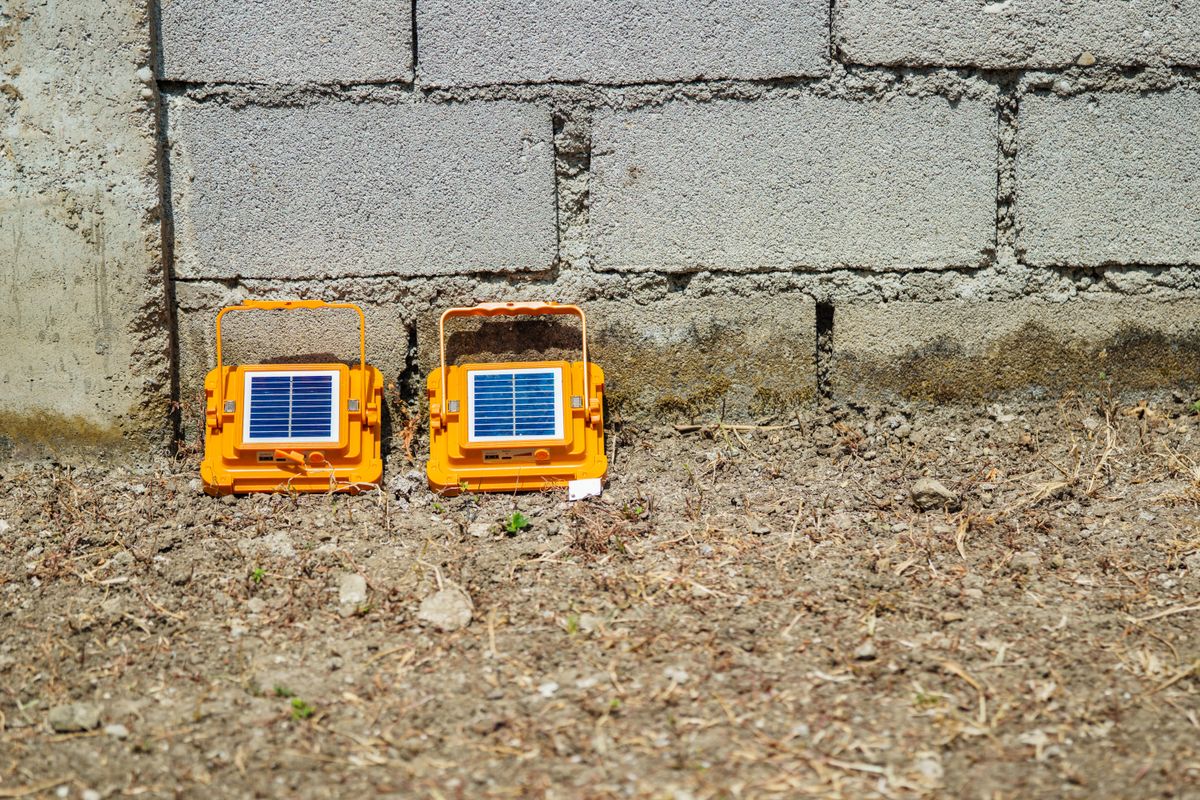
Photo by Nothing Ahead on Pexels
I tested four common solar outdoor wall light styles on the same south-facing wall after two sunny charge days. I mounted each at 72 inches, measured light at the wall and walking surface 30 minutes after dusk, then checked remaining useful light after 5 hours. These were not laboratory measurements; they were practical field observations using the same meter, location, and timing.
| Fixture style tested | Claimed output | Lux at door handle height | Lux on ground 3 ft out | Useful light after 5 hrs | What I noticed | |---|---:|---:|---:|---:|---| | Up/down wall sconce, warm white | 120 lm | 18 lux | 7 lux | Yes, dimmer but even | Looked the most architectural and least harsh | | Wide motion security light | 600 lm | 64 lux on trigger | 38 lux on trigger | Yes, if motion-only | Excellent for side yards, too jumpy for a front door | | Small decorative lantern | 80 lm | 11 lux | 3 lux | Barely | Pretty on the wall, weak on steps | | Downward wedge light | 220 lm | 31 lux | 19 lux | Yes | Best step visibility, less decorative |
Two things stood out.
First, the 120-lumen up/down sconce looked better than the 220-lumen wedge on a painted entry wall because it created a controlled vertical pattern. Second, the 600-lumen motion light was objectively brighter but made the front entry feel more like a loading dock. I would still use it at a side gate or above a trash-bin path, but not beside a doorbell unless security is the only priority.
My take: I would rather under-light a front door than over-light it
Counter to what you’ll read elsewhere: I do not think the brightest solar wall light is usually the smartest buy for a front entrance.
For a front door, I want enough light to see the lock, step, face, house number, and delivery package. I do not want a cold-white glare bomb aimed at guests. Once a fixture crosses into glare, people stop looking at the area you meant to illuminate. They look away from the light.
Where I do like higher-output solar fixtures:
- Side yards with no other lighting
- Detached garages
- Backyard gates
- Driveway-adjacent walls
- Dark corners where motion activation is useful
- Utility areas where appearance is secondary
The solar panel location matters more than the fixture body
The biggest installation mistake I see is mounting a handsome solar wall light in a location that cannot charge. Under an eave, next to a porch column, on a north-facing wall, or below a tree canopy, even a good light gets starved.
The U.S. Department of Energy’s solar resource maps show why location matters so much: annual solar energy varies by region, season, and angle. Even within one property, a south or west wall can perform dramatically better than a shaded north wall.
Here is the rule I use in the field:
- 6+ hours of direct sun: most integrated-panel solar wall lights are viable.
- 4–6 hours of mixed sun: choose a light with a larger panel, efficient LEDs, and conservative output.
- 2–4 hours of sun: use motion-only mode or a fixture with a remote panel.
- Less than 2 hours: do not expect consistent dusk-to-dawn performance.
Warm white, cool white, and why your wall color changes everything
Many solar outdoor wall lights are sold in cool white because it looks bright in product photos. Cool white, often around 5000K to 6500K, can be useful for security and utility areas. But on brick, beige stucco, stone, cedar, and warm paint colors, I usually prefer 2700K to 3500K.
Warm light makes texture look intentional. Cool light can make textured walls look chalky or harsh. On a white wall, cool light may appear crisp; on red brick, it can look flat and gray. I have seen customers replace a high-output cool-white fixture with a lower-output warm fixture and immediately prefer the second one.
Color rendering also matters, although it is not always advertised on solar lights. A higher CRI light makes plants, doors, packages, and faces look more natural. If the product lists CRI 80 or higher, that is a plus for entryways and patios.
Battery reality: capacity is not the whole story
Most solar wall lights use lithium-ion or lithium iron phosphate battery packs. A higher mAh number helps, but only if the solar panel can refill it and the electronics manage power well.
The International Electrotechnical Commission publishes standards for photovoltaic systems and components, including testing concepts around module performance and durability. Home wall lights are not utility-scale solar arrays, but the same principle applies: rated output under ideal conditions is not the same as real-world output on a shaded wall in December.
When I evaluate a solar wall light, I look for:
- Battery capacity listed clearly
- Replaceable battery access, if available
- Motion and low-light modes
- Panel size relative to claimed brightness
- Weather sealing around switches and seams
- A real on/off or mode button that can be operated without removing the fixture
Weather resistance: read IP ratings honestly
IP ratings are easy to overinterpret. An IP65 fixture is generally protected against dust and water jets, which is usually enough for exterior wall mounting. IP44 can work in covered areas but is not my first choice for exposed fences or garage walls. IP67 sounds rugged, but design still matters: water can sit behind a fixture, creep around screw holes, or collect near a switch.
My practical test is simple. Before final mounting, I look for three things:
ASTM has long published weathering and materials test methods used across plastics and coatings. A homeowner does not need to read polymer standards to buy a wall light, but it is worth remembering that UV exposure is a material problem, not just an electrical one. Cheap plastics can yellow, chalk, or become brittle before the LED fails.
My decision framework by location
Photo by Jan van der Wolf on Pexels
Here is how I choose solar outdoor wall lights by use case.
Front door or porch
I choose a warm-white fixture with a controlled beam, preferably downlight or up/down. I avoid unshielded LEDs facing forward. A lower-output architectural fixture often looks more expensive than a brighter security light.
Target: about 10–30 lux on the entry surface, with no direct glare at eye level.
Garage door wall
This is where medium-output solar sconces work well. One on each side of the garage door creates symmetry and helps visitors identify the house. If the driveway is very dark, I add a motion-capable fixture rather than relying on decorative sconces alone.
Target: even wall wash and enough light to see the driveway edge near the garage.
Side gate or narrow path
I like motion-activated downward lights here. The light should wake up before someone reaches the gate latch. This is also where cool white is acceptable if the goal is utility and security.
Target: 20+ lux on the latch or walking surface when triggered.
Patio wall
For patios, glare control is everything. A solar wall light should help people move around without killing the atmosphere. I lean warm, diffuse, and lower output.
Target: soft perimeter light, not a spotlight on seated guests.
Shed or detached structure
Here I care less about looks and more about panel exposure. A remote-panel solar wall light can outperform an integrated fixture if the shed door is shaded but the roof edge gets sun.
Target: enough light to find keys, tools, and steps after dark.
Installation checklist I actually use
Before drilling holes, I run through this checklist:
- Stand at the mounting spot at noon and check whether the panel will see open sky.
- Look for seasonal shade from trees, rooflines, and neighboring structures.
- Tape the fixture temporarily at the intended height and view it from the street.
- At dusk, hold a flashlight at the same angle to preview glare and wall shadows.
- Mount most entry fixtures around 66–78 inches high unless the design suggests otherwise.
- Avoid aiming bare LEDs directly toward eye level.
- Use anchors appropriate for brick, stucco, wood, vinyl, or masonry.
- Seal unnecessary wall penetrations, but do not block designed drainage paths.
- Charge the light fully before judging runtime.
- Test all modes before final tightening.
What I tell buyers before they choose
If someone asks me which solar outdoor wall light to buy, I ask five questions first:
Those questions narrow the choices faster than sorting by lumen claims. Solar wall lights are small energy systems attached to architecture. The right one has to satisfy both sides.
FAQ
How many lumens do I need for a solar outdoor wall light?
For a decorative front entry, I usually recommend roughly 80–250 lumens per fixture, depending on beam spread and wall color. For side yards, gates, and security areas, 300–800 lumens can make sense, especially with motion activation. The key is not just total lumens; it is whether the light lands on the surface you need to see.
Do solar wall lights work in winter?
Yes, but with shorter runtime and slower charging in many climates. Winter brings lower sun angles, shorter days, cloudier weather in some regions, and colder battery conditions. If you need reliable winter performance, choose a light with a larger panel, motion mode, and a mounting spot with the clearest possible southern or western exposure.
Are motion sensor solar wall lights better than dusk-to-dawn lights?
They are better when the location does not need constant light. Motion mode saves battery and allows a brighter burst when someone approaches. Dusk-to-dawn mode is better for ambience, house-number visibility, and gentle perimeter lighting. I often prefer motion mode for side gates and dusk-to-dawn for front porch accents.
What IP rating should I choose for outdoor wall lights?
For exposed outdoor walls, I prefer IP65 or better. For covered porches, IP44 may be acceptable if the fixture is protected from wind-driven rain. The rating matters, but so does the physical design: seams, switches, screw holes, and drainage paths often determine how well the light ages.
Bottom line
The solar wall light that wins on paper is not always the one that wins on your wall. After testing fixtures side by side, I now judge them in this order: sun exposure, beam pattern, glare control, runtime, weather sealing, then lumens.
If you want a welcoming front entry, start with shadow quality and warmth. If you want a safer side path, prioritize downward throw and motion runtime. If you want a light for a shaded wall, solve the solar panel problem before falling in love with the fixture style.
That approach has saved me from more bad installs than any lumen chart ever has.