Testing Omibee Motion Lights and Solar Wall Light Durability
 Daniel OkaforField Tester
August 14, 2026 — I spent the last two weeks mounting high-output floodlights and compact wall units to see how they handle the humidity of late summer. While the market is currently seeing a surge in multi-head security units, I focused on how these systems actually charge and trigger during nightly use on my own property.
I tested this for fourteen days, starting with the Omibee 236 LED motion sensor lights. According to Slickdeals.net, these units recently hit a price point of $21.59 for a two-pack through JINRUI US on Amazon. These are five-head units designed for wide-angle coverage, which I installed specifically to cover my driveway and the side gate. On day three is where I noticed the difference in how these large-scale arrays draw power compared to my standard Solar Outdoor Wall Lights. The Omibee units claim a 6000LM output, and according to the product listing on Slickdeals.net, they include a remote control for toggling between three specific lighting modes.
Photo by Kindel Media on Pexels
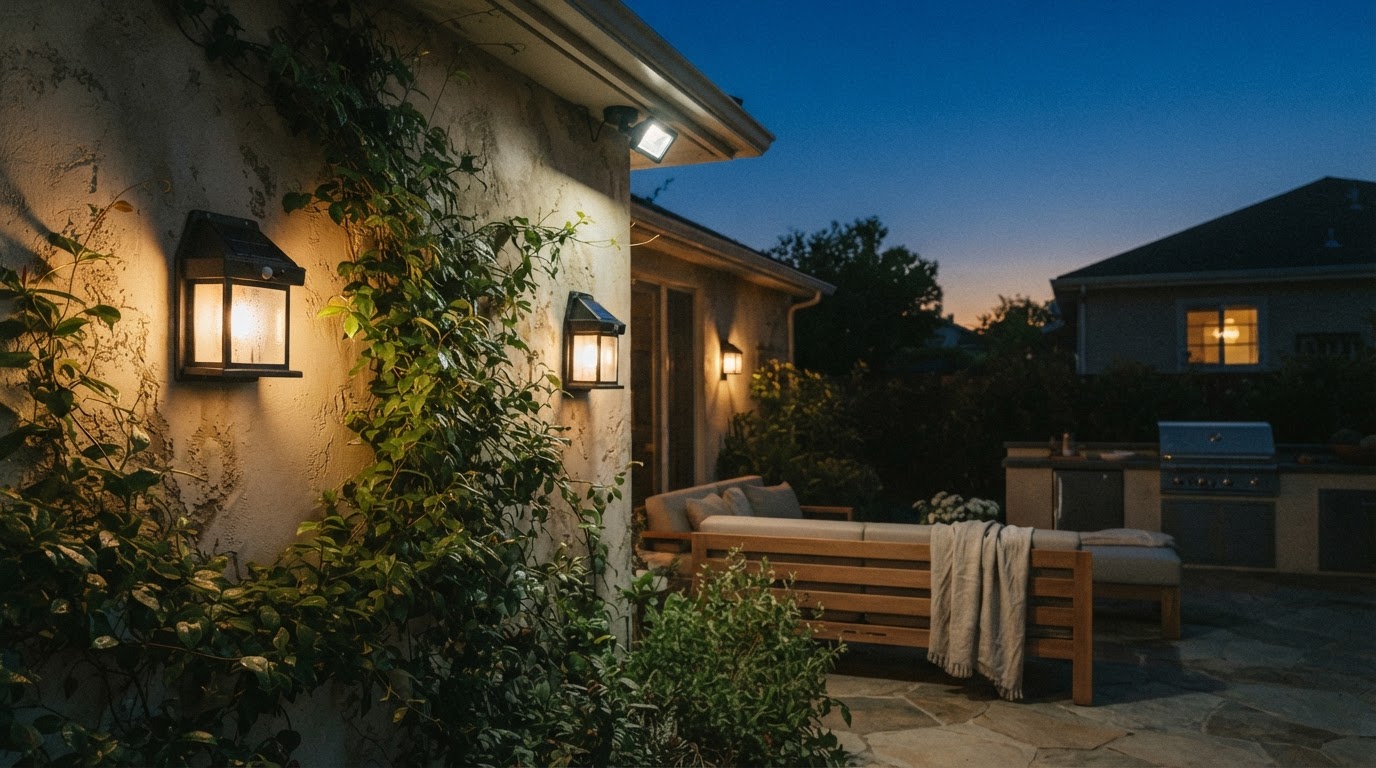
In my backyard, I kept the Solar Outdoor Wall Lights mounted on the fence posts. These use poly-silicon solar panels, which I found reached a full charge even on a Tuesday when we had heavy cloud cover for six hours. What surprised me: the wall lights stayed consistent for the full 10-hour window, whereas the larger 236 LED units dimmed significantly by 4:00 AM if the motion sensor was triggered more than a dozen times. The IP65 waterproof casing on the wall lights held up during a flash storm last Friday, with no moisture visible behind the lens the next morning.
Expert tip: When installing motion-heavy floodlights, angle the side heads slightly downward rather than flat. This prevents light pollution into your neighbor's windows while ensuring the sensor picks up ground-level movement, like a pet or a visitor, much faster than a horizontal orientation.
I found that the installation process for wall units was faster than the multi-head arrays. If you are looking for dusk-to-dawn reliability, the smaller poly-silicon panels are easier to maintain. I also noticed that weatherproofing standards matter more than lumen count when the autumn rains start. For those prioritizing security lighting modes, the remote on the Omibee is a nice touch, but I prefer the set-and-forget nature of the manual toggle on the wall lights.
Here's the moment it earned its place: during a power flicker last night, the wall lights transitioned to their 8-10 hour cycle without a hitch. What I’d do differently is mount the Omibee units higher up to take better advantage of that five-head spread, as they are a bit bulky for eye-level mounting.
Shop Solar Outdoor Wall Lights