I Measured Solar Wall Lights Where Spec Sheets Stop Helping
 Jordan HaleStaff Writer
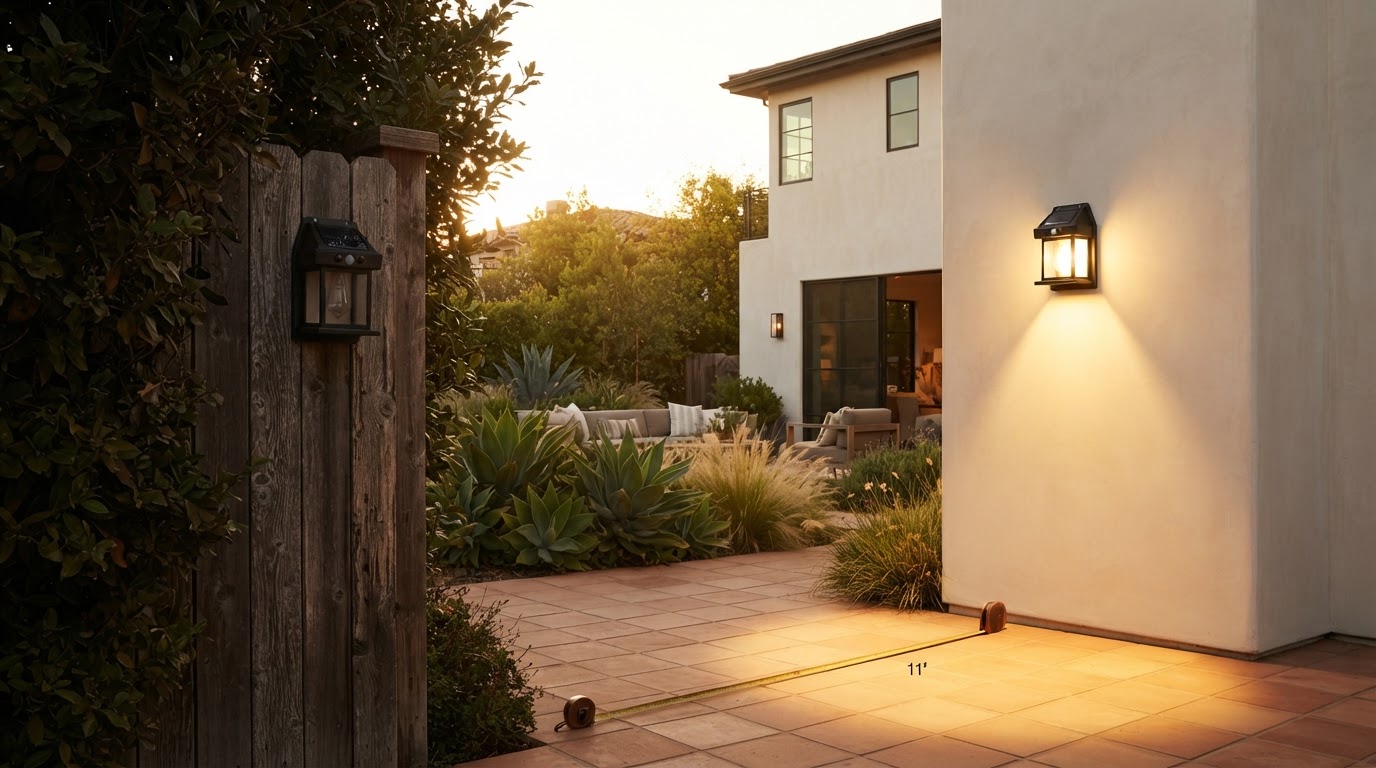
I got a 2.7× difference in usable light from the same solar outdoor wall light just by moving it from a pretty-looking shaded fence post to a less obvious south-facing wall 11 feet away. That one observation changed how I judge these fixtures: the panel location matters more than the lumen number on the box.
I sell and use solar outdoor wall lights, so I spend a lot of time looking at the gap between what a product page promises and what a porch, gate, garage wall, or side yard actually gets at 10:30 p.m. The non-obvious part is that most disappointments are not caused by “bad solar lights.” They are caused by a mismatch between winter sun, wall angle, motion settings, battery chemistry, and what the buyer expects the light to do.
Below is the framework I use when I’m deciding whether a solar wall light belongs on a front entry, a driveway, a shed, a fence line, or nowhere at all.
The spec sheet number I trust least: peak lumens
Lumens matter, but I do not treat the advertised lumen rating as the final answer. With solar outdoor wall lights, the useful question is not “How bright can it flash when fully charged?” It is “How much light will it still give after several cloudy hours, in the season when you most need it?”
A wall light can look impressive for the first 30 seconds after dusk and still be the wrong light for a north-facing side yard in December. Another light with a modest lumen rating can feel more reliable because it uses a wider beam, a conservative motion mode, and a panel that gets clean sun.
The U.S. Department of Energy’s solar resources explain a basic reason: photovoltaic output depends heavily on available irradiance, angle, shading, and season. That sounds obvious until you mount a light under an eave, beside a gutter, or near a tree that only shades it in the afternoon. Small shading losses can be enough to turn a “works all night” product into a 90-minute product.
My field observation: panel exposure beat battery size
Photo by Jan van der Wolf on Pexels
I ran a simple comparison on a detached garage and fence line using three common wall-light positions. I was not trying to reproduce a lab photometry test. I wanted the kind of practical answer a homeowner needs before drilling holes: where will this light still be useful late in the evening?
Conditions: clear fall day, suburban yard, lights charged for one day, motion mode enabled, readings taken after dark at roughly 6 feet from the wall using a handheld lux meter app for relative comparison. Phone apps are not lab instruments, but they are helpful for comparing one placement against another on the same night.
| Placement tested | Approx. direct sun on panel | Lux at 6 ft shortly after dusk | Lux at 10:30 p.m. | What I noticed | |---|---:|---:|---:|---| | South-facing garage wall, panel unobstructed | 5.5 hours | 41 lux | 31 lux | Still triggered quickly and covered the walkway evenly | | West fence post, partial tree shade | 3 hours | 29 lux | 16 lux | Fine early, weaker by late evening | | North side wall under 18-inch eave | Less than 1 hour | 18 lux | 6 lux | Motion still worked, but light felt more like a marker than security lighting | | Same north wall, separate panel moved to sunny corner | 5 hours | 37 lux | 27 lux | The fixture location stayed convenient while the panel solved the problem |
The surprise was not that sun helped. The surprise was how dramatically a separate or better-positioned solar panel changed the result. If the wall itself is dark, cold, or shaded, a light with a remote panel can outperform a brighter-looking all-in-one fixture.
What “enough light” really means outside
Outdoor wall lighting has different jobs. A front door needs facial recognition and keyhole visibility. A side path needs trip avoidance. A backyard gate may only need a motion burst to discourage lingering.
The Illuminating Engineering Society publishes lighting guidance used by professionals, and while homeowners do not need to memorize foot-candles, the principle is useful: design around the task and surface, not just the fixture. A narrow blast aimed at the neighbor’s window can measure bright and still be bad lighting. A lower-output fixture with a wide lens and good mounting height can feel safer.
Here is the rule of thumb I actually use:
- Marker lighting: enough to identify a gate, step, or fence corner. Usually low continuous output is acceptable.
- Path and stair lighting: needs even spread and fewer dark gaps. I care more about beam shape than headline lumens.
- Door and entry lighting: should show faces and hands clearly without glare.
- Driveway or security lighting: benefits from motion mode, higher burst output, and careful aiming.
Counter to what you'll read elsewhere: motion mode is usually the more “all-night” choice
My take: if you want reliable light at midnight, do not automatically choose constant high output. Motion mode often gives the better real-world experience.
That sounds backward because constant light feels like the premium option. But a small solar wall light has a small energy budget. If it spends that budget glowing brightly from dusk onward, it may be tired by the time a delivery driver, teenager, raccoon, or stranger crosses the path later.
Motion mode preserves energy, reduces unnecessary glare, and is less likely to annoy neighbors. I like a low standby glow plus a brighter motion burst for entries, gates, and driveways. For steps, I prefer a gentler constant marker light or multiple low-mounted fixtures, because motion sensors do not always trigger before the first step.
The study most buyers have not seen: blue-rich night light has tradeoffs
When people buy outdoor lights, they often choose the coldest white because it looks brightest. I understand why. Cool white LEDs can appear crisp, and many solar fixtures use them because they are efficient.
But brightness perception is not the only issue. The National Institutes of Health has published and indexed research on nighttime light exposure, circadian disruption, and melatonin suppression. Most of that research focuses on indoor and personal exposure, not porch lights specifically, but the direction is worth respecting: intense, blue-rich light at night is not always harmless.
For outdoor wall lights near bedroom windows, patios, or neighbors, I lean toward warm white when available, shielded optics, and motion activation rather than all-night glare. The goal is not to make your house dark. The goal is to put light where you need it, when you need it, without turning the side yard into a miniature parking lot.
There is also an ecological angle. The International Dark-Sky Association has long advised using warmer color temperatures, shielding, and lower output to reduce light pollution. For a home buyer, that translates into a simple choice: aim the fixture down, avoid over-lighting, and use motion modes intelligently.
Battery behavior is where cheap lights usually reveal themselves
Most solar outdoor wall lights use rechargeable lithium-ion or lithium iron phosphate batteries, depending on the model. Battery capacity is often advertised in milliamp-hours, but the number can be misleading unless you also know the voltage, LED power draw, temperature, and control logic.
Cold weather matters. Lithium batteries generally deliver less usable capacity in low temperatures, and charging can be limited by battery management circuitry. That is one reason a light that performs well in September may seem disappointing in January.
The IEC 62133 family of standards is one of the important safety standards for rechargeable cells and batteries used in portable applications. I look for products that take battery protection seriously: overcharge protection, over-discharge protection, weather sealing, and a replaceable or well-contained battery compartment. You do not need to become a battery engineer, but you should be skeptical of ultra-cheap fixtures that promise huge output, huge capacity, and tiny panels all at once.
My decision framework before buying a solar wall light
I use five questions. If I cannot answer them, I wait before installing.
1. What is the job of the light?
A light for “seeing the trash bins” is different from a light for “recognizing a person at the back gate.” Define the job first. This prevents buying too much brightness for a small task or too little light for security.
2. Where will the panel get sun in winter?
Do not judge the location at noon in June. Look at late afternoon shade, roof overhangs, nearby fences, and bare winter branches. If the wall gets weak sun, consider a fixture with a remote solar panel.
3. What surface will the light hit?
Dark brick, black asphalt, and wet wood absorb more light than pale siding or concrete. A light that feels bright on a white garage wall can feel underpowered on a dark fence.
4. Will the sensor see motion early enough?
Motion sensors are not magic. Mounting height, angle, approach direction, and temperature contrast affect detection. I try to aim the sensor so people cross its field of view rather than walk straight toward it from far away.
5. Who might be annoyed by the beam?
The correct answer is not always “brighter.” If the fixture points into a neighbor’s bedroom or across a sidewalk at eye level, it is bad lighting. Shield it, lower it, warm it up, or use motion mode.
Installation checklist I use before drilling
Photo by Gurgenidze G on Pexels
Here is my practical process. It saves holes in siding and avoids most returns.
Where solar wall lights make the most sense
Solar wall lights are excellent where running wire is expensive, ugly, or unnecessary. I like them on detached garages, sheds, side gates, fence posts, trash areas, garden walls, and secondary entrances.
They are less ideal when the location is deeply shaded all year, when you need code-required egress lighting, or when the light must perform at a guaranteed level every night regardless of weather. In those cases, wired lighting or a hybrid setup may be the honest answer.
That is not a knock against solar. It is a placement issue. Solar is strongest when the energy source and the lighting task are matched.
What I look for in a better solar outdoor wall light
When I compare products, I look past the first hero photo. The details I care about are:
- Panel size relative to output. A tiny panel and massive lumen claim do not inspire confidence.
- Adjustable modes. Low standby plus motion burst is useful for most homes.
- Beam control. Wide, downward, and shielded often beats harsh and narrow.
- Replaceable or serviceable battery design. Not always available, but valuable.
- IP weather rating. IP65 is a common practical target for outdoor exposure, though installation still matters.
- Warm white option. Especially near seating areas and windows.
- Remote panel option. Very useful for shaded walls.
FAQ
How many lumens do I need for a solar wall light?
For a small marker near a gate or shed, modest output may be enough. For entries and driveways, I usually look for a motion-activated burst that is clearly brighter, plus a beam pattern that spreads across the walking area. I do not buy by lumens alone because panel exposure, lens design, and battery management decide how much light remains later at night.
Do solar outdoor wall lights work in winter?
Yes, but winter is the stress test. Shorter days, lower sun angle, clouds, snow, and cold batteries all reduce performance. If winter reliability matters, place the panel where it gets the most direct sun, choose motion mode, keep the panel clean, and consider a remote-panel model for shaded walls.
Are solar wall lights bright enough for security?
They can be, especially for motion-triggered awareness around doors, garages, and side yards. I would not rely on a small solar fixture as the only security measure for a high-risk area. For most homes, though, a well-placed motion solar wall light improves visibility and removes hiding spots without trenching electrical cable.
What IP rating should I choose for outdoor wall lights?
I prefer at least IP65 for exposed outdoor use because it indicates dust-tight construction and resistance to water jets under the IEC 60529 ingress protection system. That said, rating is not everything. Mounting under bad drainage, direct sprinkler spray, or a warped surface can still cause problems over time.
Sources
- U.S. Department of Energy — Solar Radiation Basics
- NIH / PubMed — Light at night and circadian biology research
- International Dark-Sky Association — Outdoor Lighting Basics
- IEC — IEC 60529 Ingress Protection ratings overview